
Begin with the official consultation route
If you want to arrange a consultation, use the official Lipo Sculpt consultation page linked here. It contains the published booking information and the external payment route. This website helps you prepare for that step; it does not collect a booking request or create an appointment. Opening the official page lets you review the current information in the place where the next action is offered.
The published consultation information describes a telephone call, a £15 charge and a duration of approximately 10–20 minutes. It says the charge is deducted from treatment that is booked and completed, allows preferred callback times to be requested and says you do not have to book treatment during the call. Review that information again before proceeding because the external page controls the offer, payment destination and current explanation.
Preparation can be simple. Decide what you want the conversation to clarify, keep a small list of questions and choose a setting where you can follow the explanation. You do not need to arrive with the name of a treatment already selected. The guide below covers the practical sequence from first question to reviewing the next step. Its examples are ways to organise an enquiry, not descriptions of a guaranteed clinical process or a promise about what treatment you will be offered.
Official Book Consultation information ↗ (opens in a new tab)
Name the question you want answered
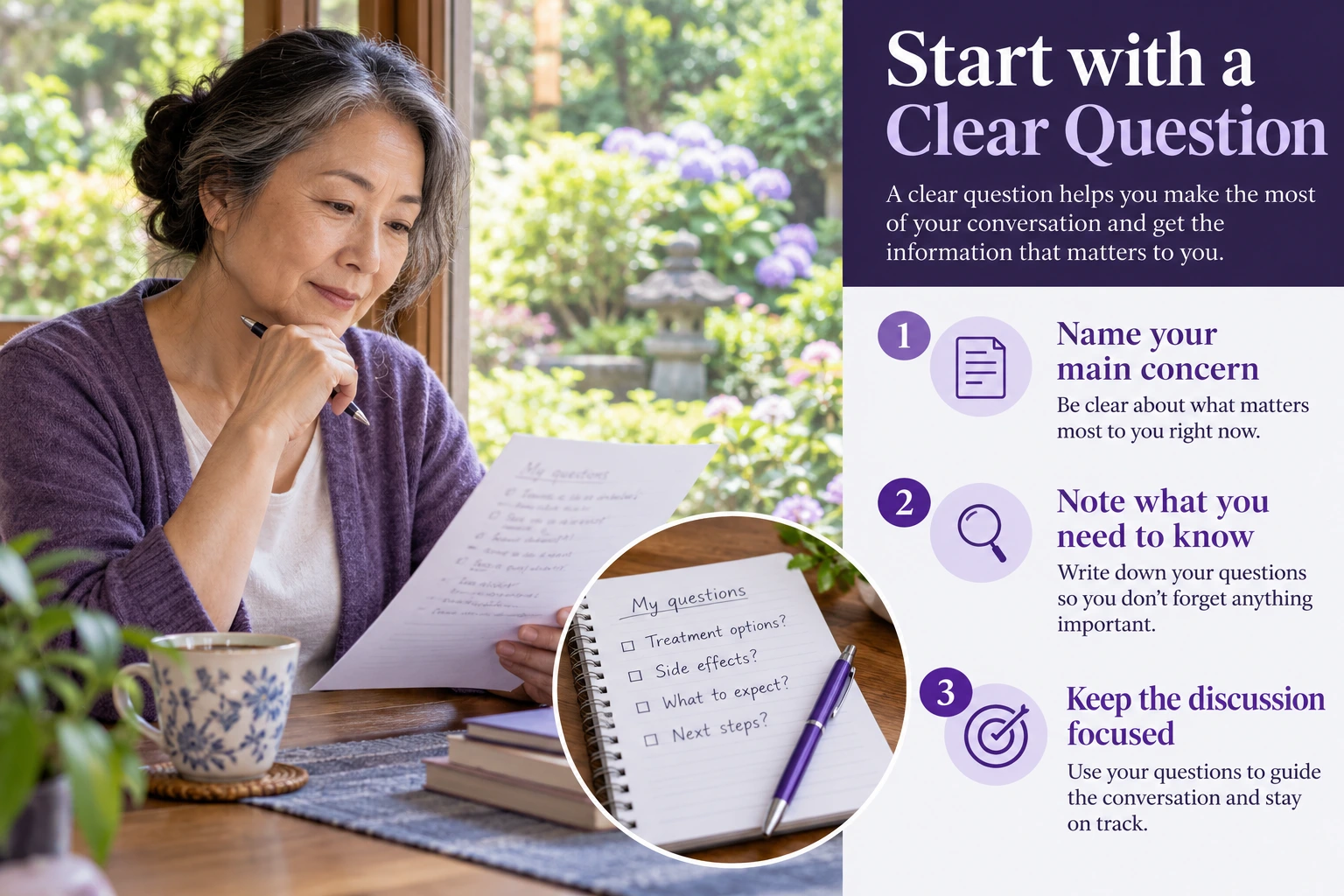
Start by deciding what would make the consultation useful for you. That might be understanding the purpose of a service, learning how an assessment is arranged or finding out which information the team needs before discussing options. A defined question is easier to revisit at the end of the call than a general wish to know everything about aesthetics.
Write the question in the words you would use aloud. You could ask how two service descriptions differ, what remains to be assessed or how a possible next appointment would be organised. Avoid substituting a technical phrase for the concern if you are unsure what the phrase means. The team can explain terminology; your preparation should help communicate your own starting point rather than demonstrate expertise.
If you have several questions, put the most consequential one first. Consider which answer would change your next action. A question about whether the discussion is appropriate for your enquiry may belong before a question about dates. A question about what a payment covers may need answering before you consider paying. This order makes the list practical without requiring every point to be resolved immediately. Leave space beside each question to record the answer and any part that still needs clarification after the conversation.
Use service pages as a reading aid
You can use the Services page to recognise the subject you would like to discuss. It introduces categories and descriptions, but it cannot select a treatment for you. Read with the aim of identifying what you understand and where a personal question begins. This is more useful than trying to compare every option from its name alone.
Keep the scope of a description in mind. A service introduction may explain a broad purpose while leaving suitability, availability and the proposed arrangement to an individual discussion. If you have found a phrase that sounds relevant, note the phrase and ask what it means in context. Do not assume that two similar descriptions refer to the same method or that one applies because its title resembles your concern.
You might make a short reading note with three parts: the page you looked at, the point you think it explains and the question it leaves open. This gives the consultation a concrete reference without turning your notes into an assessment. If you have not read any service page, you can still describe your enquiry directly. Preparation is optional support for communication. It should not create pressure to choose a service before the relevant person has explained the individual considerations and the next stage needed to explore them.
Separate general details from personal information

An initial enquiry needs enough context to identify the subject, but it does not need to become a public record of personal circumstances. Think about what you want to discuss and ask how any sensitive information should be provided. The consultation route and the channel for supporting material may not be the same. Do not send private documents or photographs through a route merely because it is easy to find.
If the team requests information, ask what is needed for the next stage and why. You may need clarification about the recipient, the method of sending it or the privacy information that applies. These questions help you understand the request before you act. This guide does not prescribe a clinical history, determine which details are relevant or provide a secure upload service.
You can prepare a reminder to raise a personal question without writing the full detail into a shared calendar entry or public social message. For example, a private note that you want to discuss a suitability concern may be enough to help you remember. The actual discussion should follow the route explained for your enquiry. Read the Privacy Policy guide if you want to understand the difference between this website and the external official pages before moving to the consultation or enquiry process.
Review the fee in its current context
Before following a payment link, read the official consultation description and check what the requested payment covers. The published fee relates to a consultation. It should not be confused with a treatment deposit, a confirmed treatment price or payment for a course. Those subjects have their own context and conditions, which need to be explained for the proposed arrangement.
If you are unsure about the relationship between consultation and treatment, ask that question before paying. You may want to clarify when a credit applies, what happens if no treatment proceeds or whether any further payment would be requested later. This page does not supply an answer where the published information and the individual arrangement need to be read together. It points you to the official route and encourages a precise enquiry about the relevant condition.
Use the destination shown on the official website, rather than treating a copied amount or an old screenshot as the complete offer. Payment technology and page wording can change. Review the recipient and description on the external page before taking action there. No card information is requested or handled here, and no local payment confirmation is generated. A successful action on another service must be understood through that service's confirmation and the booking information provided by Lipo Sculpt, rather than inferred from this guide.
Ask how callback preferences are handled
The official consultation information says that you can request a callback time that suits you. A preference is useful information for the team; it is not the same as an appointment confirmed by this website. Ask how your request will be acknowledged and how you will know the timing has been agreed. That distinction is especially helpful when you need to organise other commitments around the conversation.
Think about a few workable windows rather than one assumed slot. If your availability is limited, explain the constraint plainly. You may want to ask what happens if the proposed time no longer works or if you miss the contact. Those details should come from the actual arrangement.
Keep the agreed information somewhere you can retrieve it. A note should identify the date, time and status of the arrangement, along with any question you still need to ask. Avoid recording a requested time as confirmed until you have the relevant acknowledgement. If the situation changes, contact the team through the appropriate route and ask how to update the preference. Writing a different time in your own diary or revisiting this page does not communicate the change to the business.
Choose a setting that supports the conversation

A telephone discussion is easier to follow when you can hear clearly and give it your attention. Consider where you will take the call, whether your phone is charged and whether you have access to the notes you want to use. These are practical suggestions for participating in a conversation, not requirements imposed by Lipo Sculpt or clinical preparation instructions.
If privacy matters for the subject you want to raise, choose a setting accordingly. A speakerphone in a shared space may not be appropriate for information you intend to discuss privately. If you cannot talk comfortably at the proposed time, ask about another arrangement rather than feeling obliged to continue with sensitive detail. A clear explanation of the constraint gives the team something specific to address.
You may also want to prepare for note-taking. Keep a pen or a private document ready, but avoid trying to transcribe everything. Record the points that answer your questions, the next stage described and the matters left open. If you do not hear a word, ask for it to be repeated. If an explanation moves too quickly, say which part you want to revisit. The purpose of the call is better served by an understandable exchange than by leaving with a long list of terms whose meaning you cannot recall.
Start the call with a short overview
When the conversation begins, a brief overview can help establish the purpose. Describe the subject of your enquiry, the reading you have done if relevant and the main question you want answered. You can make clear whether you are exploring options or trying to clarify the arrangements for a particular next step. This allows the explanation to begin at an appropriate point.
An overview does not have to be polished. Ordinary language is often enough: you have seen a service description, want to understand its purpose and do not yet know what assessment would be needed. If your focus changes during the discussion, say so. A new question may be more relevant than the one you prepared. Your notes support the conversation; they do not require you to follow a script when useful information changes your understanding.
Make room for the other person to clarify the enquiry before moving into detail. You might be using a term more broadly than they are, or asking about an administrative stage they understand differently. A short explanation at the start can reveal those differences. This page cannot predict the questions you will be asked or the options you will hear. It can help you begin with enough direction that both sides understand what you are hoping to learn from the call.
Ask for an explanation you can repeat
As you hear about a possible option, consider whether you could explain its purpose in your own words. If the answer is no, identify the term or step that needs clarification. You can ask for a simpler description, an explanation of an abbreviation or a distinction between two related subjects. Understanding a name is different from understanding what is proposed.
One useful approach is to repeat the point back briefly: you understand the next step to be an assessment, with treatment still dependent on the information reviewed there. Ask whether that is correct. This can reveal an assumption before it becomes part of your plan. It also helps separate what has been confirmed from what is being discussed as a possibility.
Do not feel you must agree with an explanation immediately to keep the call moving. If it does not address your concern, say which part remains unanswered. You may understand the broad service but still need the practical sequence explained. You may understand the sequence but need a limitation discussed. These are different questions. A useful outcome is a clear record of the answer and the remaining uncertainty, even if the latter requires a further conversation with the appropriate person rather than being settled during the initial call.
Understand what still requires assessment
A telephone conversation can introduce information and help organise a next step. Ask which individual questions remain to be assessed and how that assessment would happen. This prevents administrative progress from being mistaken for confirmation of suitability. A booking discussion, possible date or payment route does not provide the same information as an individual assessment.
When an option is proposed, ask what its status is. Is it a subject to explore, a tentative plan or an arrangement that has been confirmed subject to stated conditions? You do not need to supply those labels yourself; ask the team to explain the meaning of the proposal. If further information is needed, clarify how it will be requested and who will review it.
Make a separate note of anything conditional. This could be an appointment depending on confirmation, a question needing another person's input or an aspect that cannot be established during the call. The point is not to add extra steps, but to recognise the steps that have actually been described. This guide does not decide eligibility or provide medical advice. It helps you understand the boundary between an introduction and a personal conclusion, so you can ask the right question at the stage where it can be answered appropriately.
Discuss limitations alongside the intended purpose

If the conversation moves to a possible treatment, ask about limitations as well as the intended purpose. A description may help you understand what a service aims to address, but an individual decision needs the relevant explanation of uncertainty and considerations. Do not use an illustrative image or another person's experience as a forecast for your own situation.
You may want to ask what expectations are reasonable to discuss, what cannot be promised and which parts depend on assessment. If you have a particular change in mind, describe it clearly and ask how it relates to the proposed service. It is possible for a treatment description and your expectation to sound similar while referring to different things. Discovering that difference is valuable information before a commitment.
Keep the question connected to the option actually under discussion. General claims from unrelated pages may not apply. If terminology sounds reassuring but remains unclear, ask for a concrete explanation of what it means for the proposed process. This page does not supply risk estimates, outcome predictions or clinical advice. It encourages you to obtain the information relevant to you from the appropriate professional and to recognise when a question remains open rather than treating the absence of an answer as reassurance.
Bring practical questions into the plan
An option may sound interesting while leaving practical details unresolved. Ask what the next stage involves, where its details will be confirmed and what you need to review before deciding. If attendance is being discussed, clarify the location and timing from the actual arrangement. This website does not operate an availability calendar or establish a local clinic address for your booking.
Consider the everyday commitments that may affect your choice. You could need information about the sequence of appointments, the time allowed for a particular stage or the instructions that would accompany a confirmed visit. Ask these as questions rather than relying on estimates drawn from a general service description. The relevant details may differ according to what is proposed and what remains to be assessed.
If an arrangement is suggested that you cannot manage, explain the difficulty before agreeing to it. You may want to ask whether another approach is possible, but this guide cannot promise an alternative. Keep the proposal, your preference and the confirmation distinct. Doing so makes it easier to follow subsequent messages and avoids organising travel, support or other commitments around a possibility that the business has not yet confirmed. Practical clarity is part of understanding the next step, not an afterthought once a decision has already been made.
Read appointment-change information before committing
Before accepting a booking arrangement, read the relevant terms and ask how changes would be handled. Notice periods, payments and confirmation procedures can affect a practical decision. The published terms contain differing notice wording, highlighted in the Terms & Conditions guide. Ask Lipo Sculpt which provision applies to the arrangement being discussed rather than choosing a deadline from a brief summary.
You can make the question specific by stating the stage involved. A proposed consultation, a treatment appointment and a purchased course may raise different administrative questions. Explain which one you mean and ask where the applicable condition is recorded. An answer about available dates may not answer what happens to a payment if circumstances change, so keep those points separate.
If the wording remains unclear, record the question and seek clarification before relying on it. This page does not introduce a cancellation facility or submit a change request. A visit to the guide is not notice to the business, and writing a revised date in your notes does not alter a booking. Use the route explained for the actual arrangement and obtain the relevant acknowledgement. Understanding the change process in advance gives you a clearer basis for deciding whether the proposed timing and conditions fit your circumstances.
Check the distinction between a session and a course
If more than one session is discussed, ask how the proposal is organised. You may need to understand what applies to each appointment and what applies to the arrangement as a whole. A sequence of sessions can have practical and payment conditions that are not contained in a short service introduction. Read the relevant information before treating a possible course as confirmed.
Useful questions include how dates are arranged, which details remain provisional and where the conditions can be reviewed. If a payment is mentioned, ask what it covers. Do not assume that the amount described for one stage covers every later stage, or that one appointment's conditions automatically describe the whole course. The actual proposal should be explained in its own context.
Keep a record that reflects this structure. A list of possible dates should remain a list of possibilities until confirmation. A discussion of a course should be distinguishable from an agreement to purchase it. This guide does not recommend a session count, set a treatment interval or create course terms. It helps you recognise the administrative questions that arise when a conversation moves beyond one appointment, so you can obtain the relevant explanation before organising your time or making a payment based on an incomplete understanding.
End with a clear account of the next action
Near the end of the call, bring the discussion back to what happens next. Ask whether there is an action for you, an action for the team or information that still needs to be reviewed. A brief recap can prevent several useful answers from leaving an unclear practical outcome. You should be able to distinguish the next action from the options that were simply mentioned.
Your recap might identify the document you will read, the question awaiting clarification and the method by which a proposed arrangement will be confirmed. If a follow-up is discussed, ask what its purpose will be. This keeps the later conversation focused on the open point rather than restarting the general introduction. Do not infer a response time or confirmation procedure where one has not been provided.
If you are not ready to proceed, say what you want to consider. The official consultation information says a treatment booking does not have to happen during the call. You can use the discussion to understand the next stage and then review the information. This guide does not promise that a particular option or date will remain available. It encourages a clear finish to the conversation, with the status of the proposal and the remaining questions understood before you decide on your next action.
Review your notes while the discussion is fresh
After the conversation, read your notes and check whether they still make sense. Separate confirmed information from your interpretation and from questions left open. A phrase that seemed obvious during the call can become ambiguous later. Mark it for clarification rather than building a plan around an assumption. This is particularly useful for dates, payment descriptions and conditional next steps.
Compare your notes with any information supplied for the actual arrangement. If there is a difference, identify the specific point and ask which information is current. Do not combine the most convenient parts of two versions or treat an older screenshot as a confirmation. The aim is one understandable account of what has been proposed, what has been confirmed and what remains unresolved.
Keep sensitive notes appropriately private. If you need to send a question back to the team, include enough context to identify it without copying unnecessary personal detail into an unsuitable channel. This website cannot check external booking records or confirm that a message has been delivered. The relevant acknowledgement must come through the route used for your enquiry. Organised notes can help you ask a focused follow-up, but they do not replace the confirmation of an appointment or the individual information needed for a treatment decision.
Returning with a follow-up question

Sometimes the most useful question appears after you have had time to reflect. That does not mean the earlier discussion was wasted. You may now understand the general process and need one specific point resolved. Begin a follow-up with that point and the context needed to identify the enquiry. Explain what you understood and what you want clarified.
For example, you might understand that another stage is needed but be unsure whether a suggested date is confirmed. You might have read a term and want to know how it relates to the proposal. These questions are easier to address when they are separated from a broad request to explain everything again. Ask the team which route is appropriate, especially if the question requires personal information or supporting material.
Choose the next action according to the answer you need. Use the official consultation page when you are ready to review its booking route, or use Contact Us to find the approved telephone details. This guide has no submission form, payment processor or appointment confirmation system. Its purpose is to help you prepare, participate and follow up with clearer questions. You can return to any section as a reading aid while keeping the actual arrangements and individual decisions grounded in the information confirmed for your own enquiry.